It is not enough to teach man a specialty. Through it he may become a kind of useful machine, but not a harmoniously developed personality. It is essential that the student acquire an understanding of and a lively feeling for values. He must acquire a vivid sense of the beautiful and of the morally good. Otherwise he—with his specialized knowledge—more closely resembles a well-trained dog than a harmoniously developed person.
— Albert Einstein
Modern schooling
Modern schooling – at any level – aims explicitly to prepare people for a "field of work or study". Being prepared for anything else than a "field of work or study" is a beneficial, but unnecessary, side-effect schooling.
For example the EU Qualifications Framework describes the knowledge, skills, and responsibility & Autonomy associated with level 6 and 7 (Bachelor and Master level) as follows:
| Level | Knowledge | Skills | Responsibility & autonomy |
|---|---|---|---|
| 6 | Advanced knowledge of a field of work or study, involving a critical understanding of theories and principles | Advanced skills, demonstrating mastery and innovation, required to solve complex and unpredictable problems in a specialised field of work or study | Manage complex technical or professional activities or projects, taking responsibility for decision-making in unpredictable work or study contexts; take responsibility for managing professional development of individuals and groups |
| 7 | Highly specialised knowledge, some of which is at the forefront of knowledge in a field of work or study, as the basis for original thinking and/or research Critical awareness of knowledge issues in a field and at the interface between different fields |
Specialised problem-solving skills required in research and/or innovation in order to develop new knowledge and procedures and to integrate knowledge from different fields | Manage and transform work or study contexts that are complex, unpredictable and require new strategic approaches; take responsibility for contributing to professional knowledge and practice and/or for reviewing the strategic performance of teams |
These are clearly vocation- or work-centered descriptions. If one lives to be 85 years old and works fulltime between the age of 23 and 67, then less than 20% of one’s waking hours are spend at work. Schooling prepares thus for a minority of adult life. It is therefore not surprising that many "highly educated" graduates feel woefully unprepared for adult life. They are. And they are so by design.
Schooling Induced Mental Immaturity Syndrome (SIMIS)
If children and adolescents, loyally, spend most of their childhood on school related activities, they miss out on opportunities to develop themselves as responsible adults as exemplified by taking responsibility for accomplishing mundane but necessary tasks. Hence one might expect a specific form of mental immaturity in the form of an inability to address daily mundane tasks responsibly. Individuals with this — schooling induced — immaturity need help in mundane and necessary tasks. The constant need for assistance, help, and coaching keeps activating a deep sense of inadequacy.
In general, living organisms remain alive through their own doing and not because they are helped whenever they fail to cope. An existential dependence on help from others (in effect ‘authorities’) leads to a precarious existence: at any moment this support can be withheld with dire consequences. This essential dependence lies at the root of the concept of authority. Dependence on authorities — masters — is also a defining difference between wild-type and domesticated individuals: domestic animals can have a comfortable life, but their master decides on their destiny.
In a recent paper we described agentic inadequacy as the inability of an agent to end or avoid states the agent does not want to be in. This refers again to an essential role of authorities to help one avoid or end undesirable states. But it also suggests that the individual — in part or wholly through its own doing — can be trapped in suboptimal states such as unhappiness, bad health, mental problems, or simply a lingering sense of an unfulfilled or purposeless life.
The combination of agentic inadequacy and the goals of schooling to prepare for a minority of life suggest a new syndrome with the abbreviation SIMIS: Schooling Induced Mental Immaturity Syndrome. It sufferers share many of the following characteristics and symptoms:
- They are highly educated and have loyally submitted themselves to the schooling system and its objectives
- They have known a lot at exam-time, but have forgotten almost as much
- Their school efforts have resulted in little understanding
- They develop many potentially useful work or study related skills, but lack the well-developed skills they need daily.
- They mostly trained their intellectual obedience (the well-trained dog Einstein refers to)
- They were hardly educated and so they never were given the chance to self-develop and flourish.
- They never feel in command of life and have a lingering sense of purposelessness
- They have unique personal ambitions, but hardly seem to come to realizing them
- And they have a lingering feeling that life should not be as unpredictable and unfair as it seems to be.
SIMIS — *Schooling Induced Mental Immaturity Syndrome — might be quite prevalent among the "highly educated".
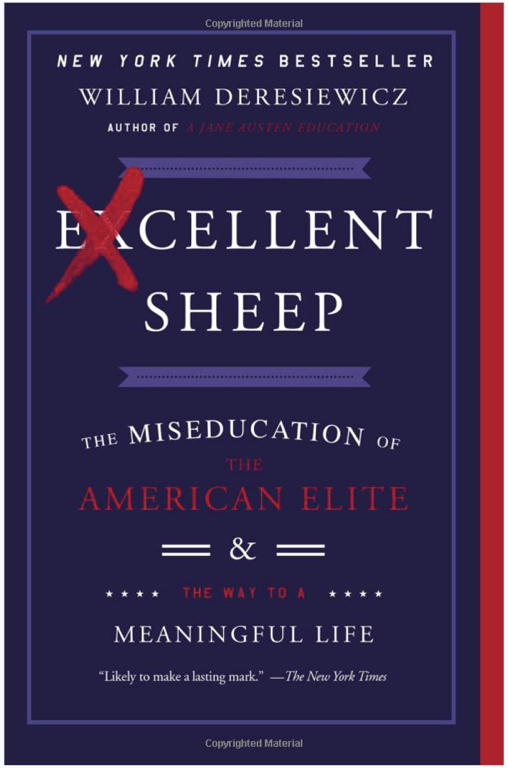
Excellent Sheep
In 2014 Yale professor Willian Deresiewicz wrote a book called "Excellent Sheep: the Miseducation of the American Elite" that seems to point to an extreme form of the SIMIS phenomenon. He describes the people who have managed to enter and finish the so-called "elite" Ivy League schools as "Excellent Sheep": highly intelligent problem solvers with minimal autonomy, because the only thing they have really proven — countless times — is how well they can solve the problems given to them by their teachers. They excel at this. But they rarely were asked what problems they thought were worth solving and what ambitions they thought were worth pursuing. As such they ended up as truly bad problem identifiers with minimal initiative.
They became the perfect adapters to the education system — any system they are part of actually — who passed through an unrelenting progression of exams and teacher-formulated projects. Later in life they function, as true apparatchiks, perfectly in any well-defined and controlled environment resembling their education. They jumped, forced or willingly, through countless hoops, but they never had the time and distance to integrate their experiences into a broad and deep understanding of reality. They are the perfect examples of the well-trained dogs that Einstein’s quote described. And although their understanding is well-developed for a dog, it is shallow in human terms. It made sense that Deresiewicz called his book Excellent Sheep.
They have a sense of entitlement based on their proven (and obedient) excellence at school and university: "we have been subjected to this near endless progression of tests and survived, so we are entitled to a high salary and high status". And because monetary and status awards have been the driver of their compliance with the educational system, they have no deeper purpose in life and without it they lead unfulfilling and unhappy lives. They committed loyally to the system and got trapped somewhere along the way: and they have no clue how to liberate themselves, so they continue in the way they are trained for: by propping up the system that made them feel empty, hollow, and miserable.
Deresiewicz’ description of the life the students he schooled lead after graduation is not a favorable one. And it was his former students that informed him of it.